
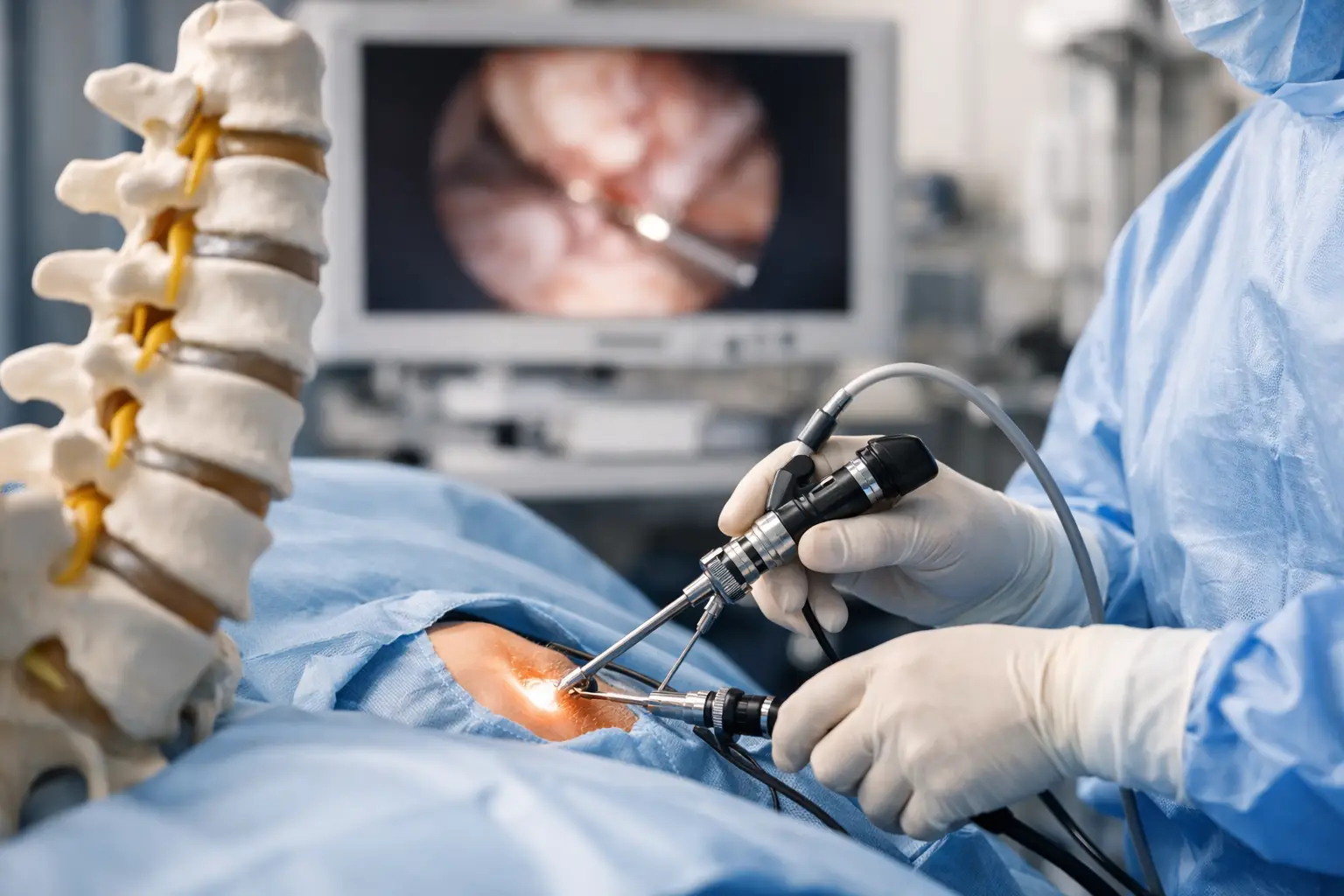
For many people, the words “spine surgery” bring to mind long scars, weeks in bed and a slow, painful recovery. Thanks to advances in technology, that picture has changed. Endoscopic spine surgery in Ahmedabad now allows surgeons to treat many common spine problems through an incision smaller than a centimetre, with most patients walking within hours and going home the same day or the next.
In this guide, Dr. Shailendra Solanki, a brain and spine surgeon experienced in microscopic and minimally invasive techniques, explains how endoscopic spine surgery works, who benefits the most, and what recovery really looks like.
What Is Endoscopic Spine Surgery?
Endoscopic spine surgery is an advanced form of minimally invasive spine surgery. The surgeon inserts a thin tube carrying a high-definition camera, light source and water channel, called an endoscope, through a tiny skin incision. The magnified image appears on a large monitor, allowing the surgeon to see the nerve and disc clearly and remove the cause of compression using fine instruments passed through the same tube.
Muscles are moved aside rather than cut, so tissue damage is minimal.
Types of Endoscopic Spine Procedures
- Transforaminal endoscopic discectomy: The endoscope enters from the side through the natural opening where the nerve exits the spine.
- Interlaminar endoscopic discectomy: The approach is from the back, through the gap between two vertebrae.
- Unilateral biportal endoscopy (UBE): Two small portals are used, one for the camera and one for instruments, offering greater flexibility for spinal stenosis.
- Endoscopic cervical procedures: Selected neck disc and nerve compression problems can also be treated endoscopically.
Benefits of Endoscopic Spine Surgery in Ahmedabad
Patients choosing endoscopic spine surgery in Ahmedabad can expect several advantages over conventional surgery:
- Tiny incision, usually about 8 to 10 mm, with minimal scarring.
- Less muscle and tissue damage, which means less pain after surgery.
- Minimal blood loss and a lower need for strong painkillers.
- Short hospital stay, often same-day or next-day discharge.
- Lower infection risk due to continuous saline irrigation and smaller wounds.
- Faster return to work and daily activities.
- Often possible under regional or light anaesthesia in suitable patients.
Conditions Treated with Endoscopic Spine Surgery
The best endoscopic spine surgeon in Ahmedabad will recommend this procedure only when it suits your specific condition. Common indications include:
Lumbar Disc Herniation and Sciatica
A herniated lumbar disc pressing on the sciatic nerve is the most common reason for endoscopic surgery. If you are dealing with persistent leg pain, read our guide on sciatica pain treatment in Ahmedabad.
Lumbar Spinal Stenosis and MIS Spine Surgery
Age-related narrowing of the spinal canal can compress nerves and cause leg pain or heaviness on walking. Endoscopic decompression removes thickened ligament and bone spurs to free the nerves.
Foraminal Stenosis
When the opening through which a nerve exits becomes narrow, endoscopic foraminotomy can widen it with minimal disturbance to surrounding structures.
Selected Cervical Spine Problems
Some neck disc herniations and nerve root compressions causing arm pain can be treated endoscopically. For more complex neck problems, consult a cervical spine surgeon in Ahmedabad.
Who Is Not a Candidate for Endoscopic Spine Surgery?
Endoscopic surgery is excellent, but it is not suitable for everyone. It may not be the right choice when there is:
- Significant spinal instability or slippage of one vertebra over another that requires fusion.
- Severe spinal deformity, such as advanced scoliosis.
- Large spinal tumours or extensive infection.
- Complex spine fractures following major trauma, which often require stabilisation. Learn about spine fracture treatment in Ahmedabad.
In such cases, other forms of MIS spine surgery or open surgery may give better long-term results.
The Endoscopic Spine Surgery Procedure: Step by Step
Before Endoscopic Spine Surgery
Your surgeon reviews your MRI, examines you and explains the plan. Routine blood tests and a fitness check are done. Most patients are admitted on the day of surgery.
During the Endoscopic Spine Procedure
- The patient is positioned and anaesthesia is given.
- Using live X-ray guidance, the surgeon marks the exact entry point.
- A small incision is made and the endoscope is guided to the problem area.
- The disc fragment, bone spur or thickened ligament pressing on the nerve is removed under direct vision.
- The incision is closed with a single stitch or adhesive strip.
Most procedures take about one to two hours, depending on complexity.
After Surgery: Walking Within Hours
Patients are usually encouraged to walk within a few hours. Many notice immediate relief in leg pain, while numbness may take longer to settle as the nerve heals.
Recovery Timeline After Endoscopic Spine Surgery
- Day 0–1: Walking, discharge home in most cases.
- Week 1–2: Light household activities, short walks, wound care.
- Week 2–3: Return to desk-based work for most patients.
- Week 4–6: Start structured physiotherapy and core strengthening.
- Week 6–12: Gradual return to heavier work, sports and gym activities as advised.
Recovery after endoscopic spine surgery in Ahmedabad is usually much faster than after open surgery, but every patient heals differently, so follow your surgeon’s personalised instructions.
Endoscopic vs Open Spine Surgery: A Quick Comparison
Traditional open surgery requires a larger incision and more muscle separation, which can mean more pain, a longer hospital stay and slower recovery. MIS spine surgery in Ahmedabad, including endoscopic techniques, achieves the same goal of freeing the nerve with far less disruption. Open surgery still has a place for complex deformity, instability and trauma, which is why a surgeon trained in both approaches can offer the most balanced advice. Explore our minimally invasive spine surgery in Ahmedabad services to learn more.
Is Endoscopic Spine Surgery Safe? Understanding the Risks
Endoscopic spine surgery has an excellent safety record when performed by a trained surgeon in a well-equipped hospital. Because the incision is small and the area is continuously washed with saline, the chance of wound infection is very low. However, like every operation, it carries some risks that your surgeon will explain before you decide:
- Temporary numbness, tingling or a burning sensation in the leg as the nerve recovers.
- A small leak of spinal fluid, which is usually repaired during the same procedure.
- Recurrence of a disc herniation at the same level in a small number of patients.
- Rarely, the need to convert to a microscopic or open procedure for safety.
Preparing for Your Consultation
Bring all recent MRI and X-ray films and reports, a list of your current medicines (especially blood thinners), and details of treatments you have already tried. Write down when your pain started and what makes it better or worse. This helps the surgeon decide quickly whether endoscopic surgery is the most suitable option for you.
How to Choose the Best Endoscopic Spine Surgeon in Ahmedabad
Endoscopic surgery has a learning curve, and results depend heavily on the surgeon’s experience. Look for:
- Specialised training in endoscopic and microscopic spine surgery.
- A clear, honest explanation of whether you are truly a candidate.
- Access to a well-equipped spine hospital in Ahmedabad with modern imaging and operating theatres.
- A structured post-operative rehabilitation plan.
Frequently Asked Questions About Endoscopic Spine Surgery in Ahmedabad
Is endoscopic spine surgery in Ahmedabad painful?
Discomfort after surgery is usually mild and well controlled with routine painkillers, because the muscles are not cut.
How long do the results last?
When the cause of nerve compression is removed, relief is generally long-lasting. A healthy weight, good posture and regular exercise help protect the spine.
Will I need a fusion later?
Most patients treated for a simple disc herniation do not need fusion. Your surgeon will assess spinal stability before recommending any procedure.
Can elderly patients undergo endoscopic spine surgery?
Yes. Because it involves less blood loss and can often be done under lighter anaesthesia, endoscopic surgery is frequently a good option for older adults who are not fit for major open surgery.
Conclusion: Less Invasive, Faster Recovery
For the right patient, endoscopic spine surgery in Ahmedabad offers effective relief from disc and nerve pain with a smaller wound, less pain and a quicker return to normal life. A detailed consultation is the first step to finding out whether it is right for you.
Book your spine consultation with Dr. Shailendra Solanki today. Call +91 89800 15565.